ENGINEERING LOG / AUTOMATED IMPLANT PRODUCTION
Build the line.
Prove every move.
A full production-line simulation, from titanium stock to inspected and packaged parts. Follow the executable checkpoints as the line takes shape.
09 / Through the CAD machine openings. To packaging.
A mobile UR10e physically loads and unloads three CNC stations built from manufacturer Haas CAD, then carries the part through finishing, cleaning, final inspection and packaging. Four CNCs are present; this recipe uses three. Nine operations and nine verified grasps completed, both inspections passed, and no handling faults were logged. Fixtures, finishing equipment, mobile hardware and actuation remain provisional.
FINISHING VALIDATION / CONTACT AND TIMING
A part must settle without sinking into its support.
The CAD-derived implant drops from the tilting bowl onto a receiving sieve. The bowl returns and the receiver shuttles outward. This is an actual MuJoCo recording of the isolated mechanism; robot loading and extraction are not shown.
41.407 SIM SECONDS · 4× PLAYBACKA full-batch trial exposed excessive sieve penetration and part drift. The candidate uses finer physics steps, a shorter contact response and waits measured in simulated seconds. It distinguishes upward support from sideways forces and stops if sieve penetration exceeds 0.5 mm.
This checkpoint completed reception, bowl return and shuttle transport. Maximum observed sieve penetration was 0.213 mm. Sequence timing, retained source hashes and all 311 video frames passed the audit. The part is small in this view; the bowl partly obscures its initial position and landing.
The initial part position is taken from a production record, with an explicitly assumed flat orientation and zero velocity. Bowl, sieve and fixtures are provisional. Contact settings are numerical experiments, not calibrated titanium properties. The corrected full two-part batch is still under test; this checkpoint does not establish full-line reliability, medical acceptance or real-hardware readiness.
INTEGRATED TRANSFER / CAD MACHINE LOADING
Stock to pallet. Pallet to CNC.
The UR10e and imported Robotiq gripper pick raw stock, place and release it on a linear carrier, withdraw, and retrieve it after 200 mm of contact-driven transport. The carrier returns empty. The robot then opens CNC 1, inserts the same part, verifies seating, releases it and retreats.
348.388 SIM SECONDS · 4× PLAYBACKThis checkpoint uses the production transfer backend. Both robot grasps use physical contacts; the carrier transports a free workpiece without attachment. The retained history/source and complete video decoding/timing audits passed. Some carrier details are occluded in the follow-camera view; the linked observations provide separate contact and seating evidence.
The part remains RAW_STOCK: this test does not run machining or complete production. Carrier, fixture and mobile-base geometry remain provisional; CNC enclosure meshes derive from manufacturer CAD. Repeated pallet-enabled production and multi-part occupancy remain unqualified.
COMPLETE CONFIGURED ROUTE / IMPORTED CONTACT GRIPPER
Raw titanium stock to inspected, packaged part.
The UR10e and Robotiq 2F-85 retrieve raw stock, tend three CNC stations, perform intermediate inspection, transfer through bowl grinding/polishing, retrieve and reorient the discharged part, load the immersion cleaner, then complete final inspection and packaging. The same physical part persists through all eight recipe operations.
PACKAGED · 1783.426 SIM SECONDS · 8× PLAYBACKBoth inspections passed. The retained route, handling and process-timing audit passed, and captured source files remained unchanged during execution. Robot grasps use physical contacts; fixture retention uses explicit verified hybrid constraints. CNC enclosure meshes derive from manufacturer CAD. Fixtures, finishing equipment, the mobile base and process durations remain provisional. This is a completed simulation checkpoint, not hardware or medical-device qualification. The full project acceptance work remains ongoing. A separate two-part full-route trial stopped at a finishing return-displacement check; diagnosis is in progress.
ENGINEERING CHECKPOINT / FINISHING INTERFACE PASSED
Finished-part discharge, pickup and turnover.
The robot loads a finished-geometry specimen into the provisional bowl, waits for the configured grinding/polishing process, then retrieves the physically discharged part from the sieve. The part arrives on its side. After contact-only pickup, an end-clamp fixture rotates it 90 degrees; the robot regrasps it, resets the mechanisms and departs.
INTERFACE PASSED · 456.688 SIM SECONDS · 4× PLAYBACKThis test starts with an already-finished specimen and does not claim a completed manufacturing route. All three robot grasps use physical contacts. The turnover fixture uses an explicit contact-verified hybrid constraint. The rigid media surface, fixture and mobile base are provisional; impact damage and hardware performance remain unvalidated. The complete imported-gripper production run has since completed and passed its retained history/source audit; see the full-route checkpoint above.
Following the failed trial below, the receiver grasp uses an observed 10 mm TCP offset and discharge waits for measured support and stability. The recorded source snapshot was verified unchanged.
ENGINEERING CHECKPOINT / FAILED RECEIVER ACCESS
Loading worked. Receiver pickup was rejected.
The imported Robotiq gripper physically picks raw stock, releases it 25 mm above the provisional rigid media bed, and withdraws. Grinding/polishing process timers complete, the bowl discharges the part, and the receiver extends. Both proposed pickup orientations then fail collision checks against the sieve bars. The run stops at 265.532 simulated seconds without retrieving the part.
FAILED TRIAL · 4× PLAYBACKThis is a raw-stock interface test, not a completed implant route. The successful follow-up above uses an elevated grasp and observed settling. The earlier full-route videos use a different gripper. Media behavior, impact damage and hardware performance remain unvalidated.
Evidence for the recorded CAD route
The history audit passed. All 312 compared core motion/process events, inspection results, part mass and completion time match the earlier unrecorded execution. The door uses a documented partial stroke and localized guide approximation. Grasp and workholding use contact-verified hybrid constraints. This is simulated process and handling evidence, not certified manufacturing or industrial safety validation.
CHECKPOINT 14 / COMPLETE CAD-LINE ROUTE
From stock through CNCs, finishing and packaging.
The complete route now combines manufacturer-derived CNC enclosures with physical same-bowl grinding/polishing, discharge and receiving sieve, turnover/regrasp, immersion cleaning, final inspection and packaging. The small titanium plate completes eight operations in 1,731.61 simulated seconds. Both inspections return PASS; final disposition is PACKAGED. This 216.47-second video plays at 8×.
The retained history audit passes, including finishing-phase timing and discharge ordering. Captured production sources remained unchanged during execution. Workpieces use discrete CAD process outcomes; material cutting is not simulated. Production grasping and seating still use explicit contact-verified hybrid constraints. Fixtures, finishing mechanisms, mobile base and process durations remain provisional. The imported contact-only gripper and pallet trials below are separate demonstrations, not replacements in this full-line run.
PHYSICAL TRANSFER MECHANISM / CANDIDATE
Place it. Transport it. Pick it again.
The robot places a finished representative plate on an actuated linear carrier, releases and retreats, waits for measured arrival, and retrieves it at the receiving position. The carrier moves 200 mm; the free part follows through contact friction without an attachment constraint. This recording uses real-time playback.
Observed maximum transport pose error: 0.141 mm. Position, support contact, orientation and stopped-state checks guard arrival. A separate 5 N disturbance test loses support and stops the trial before arrival is accepted. The prismatic joint idealizes the guide bearings; the narrow seat, lumped carriage mass and rail geometry are provisional. Detailed chassis, guards, conveyor belts and shared inventory remain unfinished. The newer pallet-to-CNC checkpoint above demonstrates one integrated production-backend transfer.
PHYSICAL CAD TENDING / IMPORTED GRIPPER
Load, clamp, process, retrieve.
The imported UR10e and Robotiq models execute a complete tending cycle through the manufacturer-derived Haas enclosure: open and verify the door, pick a representative finished plate, enter the loading opening, seat and release, withdraw, clamp, close, run a four-second simulated process, reopen, regrasp before unclamping, extract and return the part to its support.
Both grasp and workholding use physical contacts without part attachment constraints. The trial reuses the production machine-state transitions and checks door, seating and clamp observations during the timed process. It completes in 200.970 simulated seconds; this 50.27-second recording plays at 4×. The audit confirms 14 transitions and the configured process duration. Its JSON event history exactly matches the earlier unrecorded trial.
These are separate candidate-tool tests. The full-line controller still uses its existing gripper. End clamps, support geometry and the flange interface remain provisional; ideal model bias compensation is used. The trial performs no cutting or geometry change and does not establish hardware performance, safe gripping forces or medical-device acceptance.
IMPORTED TOOL / CONTACT-ONLY HANDLING
UR10e and Robotiq: physical pick and place.
The imported Menagerie Robotiq 2F-85 model grasps a finished representative plate, lifts it, transfers it between supports, seats it, releases it and withdraws. This 29-second recording runs at real-time playback. The part remains a free rigid body held by contact friction; no grasp attachment constraint is used. Both finished plate families passed separate trials.
Small-plate result: 0.356 mm maximum relative grasp slip and 0.144 mm release position error. These are simulated observations with ideal model bias compensation, provisional supports and an unverified flange interface—not hardware accuracy or qualified gripping forces. The full-line controller still uses its existing gripper.
A separate CAD check found sampled open-door insertion/descent poses clear for the complete candidate arm/gripper and a hypothetical centered part; the closed-door negative control detected interference. That check omits the fixture and does not prove physical machine loading, clamping, door sweep or continuous clearance.
LATEST / EXECUTED PRODUCTION RECIPE
13 / Grind and polish in one bowl. Then clean, inspect and package.
Three CNC operations and in-process inspection lead to physical bowl loading. Separate grinding and polishing timers run before one discharge onto the receiving sieve. The robot retrieves the part, uses the turnover fixture, resets the mechanisms, and continues through immersion cleaning, final inspection and packaging. The separate generic polishing station is removed from this configuration.
1,455.780 simulated seconds · 8 operations · PASS / PASS · PACKAGED · 182-second video at 8×
The operation history and retained source-hash/change-report audits passed. Grinding and polishing each ran for three configured simulated seconds; these are demonstration durations. Same-container finishing follows a process architecture described in OTEC's medical brochure. Equipment geometry, media and quality effects remain provisional. No abrasive or material-removal physics is claimed. This recording uses provisional CNC enclosures; the manufacturer-CAD route remains a separate checkpoint. Source integrity is not proof of deterministic replay or real-world readiness.
OFFLINE FEASIBILITY EVIDENCE
Check access before production.
Separate CAD-scene checks cover CNC input/output shapes (raw, drilled and finished), loading and transport-stow paths, a 180° rotation at stow, five ordinary process/output fixtures, and the CNC 1 to in-process-inspection aisle route. Each linked report states its own scope. The reports were generated by incremental versions of the checker; they are not one unified full-line certification.
Checks use sampled full-arm/gripper poses and hypothetical carried or seated workpieces. An independent convex-workpiece/box penetration check supplements MuJoCo contacts. They do not establish continuous swept clearance, dynamic grasp retention, localization uncertainty or verified equipment dimensions. Dedicated bowl-discharge and immersion-carrier access preflight remains incomplete.
INTEGRATED PRODUCTION RECIPE
12 / From titanium stock to packaging, through physical finishing.
The small implant passes through three CNC operations, in-process inspection, physical bowl loading and discharge, observed-pose retrieval, turnover and regrasp, polishing, carrier immersion cleaning, final inspection and packaging. The finisher receiver and turnover fixture reset after extraction. Nine recipe operations, ten verified grasps, both inspections PASS and verified packaging; 1596.072 simulated seconds.
199.53 seconds of actual executable MuJoCo video at 8× playback. The recorded history audit passed. Final outcomes and total simulated time match the unrecorded run; 180 of 281 selected events match exactly. Later motion observations differ slightly after a world-frame code change, so this comparison does not establish bit-exact replay. All machine enclosures and finishing interfaces in this recording are provisional project geometry. This video demonstrates the integrated physical sequence; checkpoint 09 separately shows the manufacturer-derived CNC enclosures. Cutting, abrasion and cleanliness are process models, and quality results are simulated. The later cast-shadow display option is not used in this recording.
The longer plate also completed the same physical-finishing architecture with four CNC operations: ten recipe operations, PASS/PASS and packaging at 1774.768 simulated seconds. This is separate unrecorded evidence, not part of the small-plate video.
PHYSICAL FINISHING AND REORIENTATION
11 / Discharge. Observe. Reorient. Load.
The robot loads a provisional finishing bowl. Its tilt mechanism discharges the plate onto a sieve, and a contact-driven shuttle presents it for retrieval. The robot observes the plate pose, retrieves it, loads an end-clamp turnover fixture, withdraws for a quarter-turn correction, and grasps the upright plate again. It then travels to CNC 1, seats the plate, withdraws, verifies clamping and closes the door.
425.680 simulated seconds, three verified grasps, 0.110 mm receiving-seat error; 106.43 seconds of actual MuJoCo execution at 4× playback. The recorded sequence audit passed. This is a focused handling checkpoint, not the complete production recipe. Bowl, rigid media-bed proxy, narrow gripper, turnover fixture and receiving CNC geometry are provisional. Media particles, abrasion and material removal are not simulated. Clamp and grasp constraints activate after contact verification. The newer empty-fixture reset is tested separately and is not shown in this recording.
NEW PHYSICAL HANDLING CHECKPOINT
10 / Into the cleaning bath. Back to the robot.
The robot loads a two-axis carrier and withdraws. The carrier lifts, crosses the bath rim, immerses the part, dwells, drains and returns. The robot then retrieves the part and seats it in CNC 1 as the next receiving station. Two verified grasps and 318.270 simulated seconds; receiving-seat error 0.117 mm. This focused checkpoint uses provisional equipment geometry and explicit hybrid retention. It does not certify cleanliness or complete the manufacturing recipe.
Actual MuJoCo execution, 4× playback. The recorded sequence audit passed; a separate corrected full recipe completed in 1418.864 simulated seconds with both inspections passing and the part packaged. This later controller also bounds commanded joint speed and acceleration; checkpoint 09 retains its original controller and timing.
THE COMPLETE ROUTE
One continuous manufacturing history.
The prototype now connects the full handling route. The next work replaces provisional assumptions with verified equipment interfaces and extends physical and metrology validation. The complete engineering goal remains active.
- Raw-material storage, identification and feeding
- Recipe-driven CNC operations and orientation changes
- Intermediate inspection and station-to-station transfer
- Finishing and process-specific preparation
- Final inspection, packaging or rejection disposition
Geometry behind the run
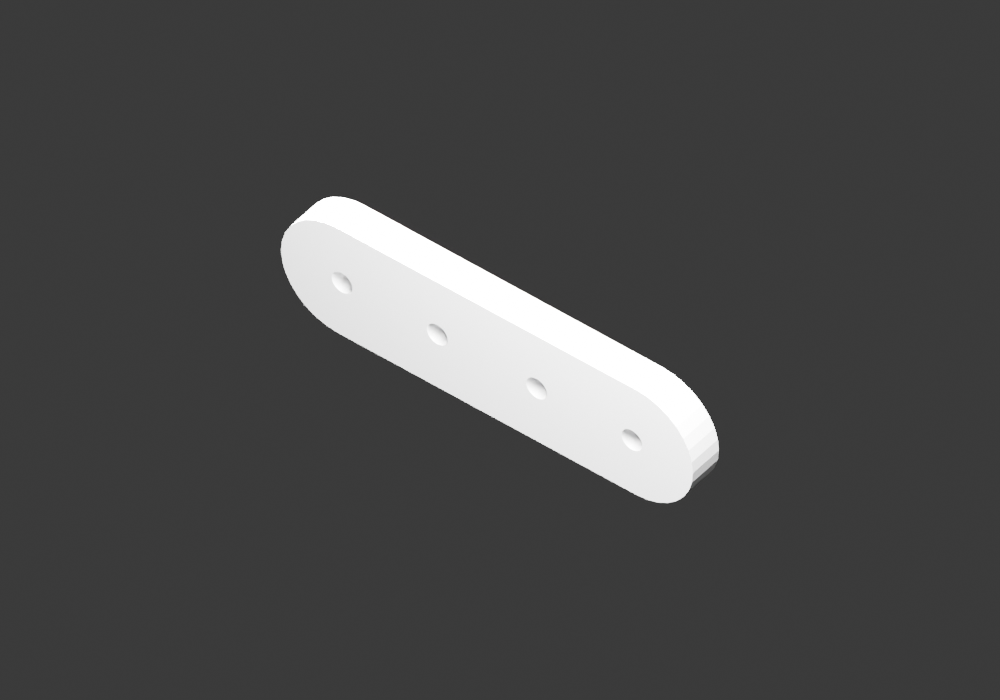
Project-generated representative plate CAD: a rounded blank, four drilled through-holes, then a smaller finished contour. Hole-preserving collision pieces are checked in MuJoCo. This separate Blender preview shows the finished asset; the video above records the physical production run.
ARCHIVE / 04
Earlier full route with provisional CNC geometry.
The staged-geometry prototype completed in 845.410 simulated seconds. Retained as an earlier checkpoint.
08 / UNCERTAINTY CHANGES THE ROUTE
Inconclusive means hold.
After CNC 1, simulated dimensional inspection cannot make a reliable acceptance decision: configured measurement uncertainty is 0.2 mm against ±0.1 mm tolerances. The mobile robot retrieves the part and physically delivers it to hold. Manufacturing state remains ROUGHED; no package is created.
359.042 simulated seconds · 8× playback · provisional equipment geometry. The recorded run exactly reproduces the earlier event history except its unique run ID. This demonstrates configured uncertainty-aware routing, not certified metrology.
LATEST CHECKPOINT / 07
Load the CAD machine. Run the cycle. Retrieve the part.
A UR10e physically retrieves a representative titanium blank, inserts it through the Haas CAD-derived opening, seats and releases it, withdraws, verifies clamping and door closure, completes timed OP10, reopens, grasps and extracts the part, then returns it to presentation. The 126.254-second simulation is shown at 4x playback.
All 18 selected machine components have collision representations. The recorded run contains two contact-verified grasps, verified seating, machine transitions and no logged collision or alarm. The first transfer struck the pendant during planning; a revised route then reached an IK branch limit. Both failures were retained before a connected, collision-checked route completed.
Scope and limits: one machine and one simulated operation. The fixture, gripper, pedestal and actuator settings are provisional; grasp and workholding use verified hybrid constraints. The documented lower-door guide model, partial opening and 2 micrometre CAD seam correction remain in use. Conservative collision approximations are not manufacturer-certified clearances. OP10 does not simulate cutting or change the blank. The full production-line prototype above still uses provisional CNC machines.
ACCESS EXPERIMENT / 06
Manufacturer CAD. Executed access test.
A Haas UMC-500/SS assembly from manufacturer CAD now runs a 0.60 m partial door opening and return in MuJoCo. This ten-second recording shows actuator-driven motion at 1x speed. The geometry probe is blocked when closed and passes through the partial opening.
Explicit provisional interface: the supplied closed-door CAD overlaps the enclosure below the opening. A slide constraint replaces contact between the lower door skirt and enclosure only; the skirt remains collision-active against external objects. Mass, actuator settings, direction and travel remain provisional. Full-stroke testing failed near 0.657 m and is not claimed as working.
This isolated access experiment has no robot or workpiece. Internal geometry is visible but its collisions and fixture interface are not yet integrated. The full production route above still uses provisional machines. This checkpoint does not establish real-machine tendability.
TOOL CHECKPOINT / 05
Dock. Verify. Couple. Return.
The robot approaches a parked parallel-jaw gripper, verifies support and mating contact, closes an actuated latch, couples and lifts the tool, then returns it and withdraws. Tool identity is committed after verification. This 38.450-second recording runs at 1x speed.
The gripper is a separate physical body. Retention uses an explicitly verified hybrid coupling; locking-ball mechanics are not simulated. This demonstrates acquisition and return of one tool. A separate full-line run acquired it, completed nine production operations and packaging, then returned it to the rack. Exchange between different end effectors remains pending.
Earlier checkpoints
03 / First complete handling route — raw stock to packaging with an unchanged blank.
02 / Physical clamp verification — actuator-driven fixture clamps added to the tending cycle.
01 / First physical loading and unloading cycle — the initial fixture used verified support and a hybrid holding constraint. Checkpoint 02 adds physical clamps.
ARCHIVED CHECKPOINT 04 EVIDENCE
OBSERVABLE, REPRODUCIBLE PROGRESS
Inspect the run behind the video.
The recording comes from the executable physics run. The fixture now has actuator-driven clamp pads. Machining requires both clamp contacts, verified seating and a closed door. Grasp retention and workholding also use explicitly logged hybrid constraints after contact checks. Machining is a timed process followed by a discrete precomputed CAD outcome; cutting forces and continuous metal removal are not simulated. The part remains in its physical pose when geometry changes. Its mass decreases from 93.129 g to 88.310 g.
What this checkpoint establishes
The CAD route executes physical transfers through machine openings, orientation changes, verified clamping, timed processes and packaging. The longer plate has also completed a separate four-CNC route using manufacturer-derived CNC enclosures and provisional fixtures. Other verified runs demonstrate quarantine, hold, bounded completion-fault retry and quality rework.
What remains to be established
Verified production fixtures and finishing hardware, batch finishing reliability, contoured-part metrology, multiple-end-effector exchange, additional transfer/recovery modes, and real-hardware transfer. These simulation results are not medical-device acceptance or industrial safety certification.
Additional executed checks
These separate runs are not shown in the CAD video above. A bounded simulated completion-fault retry finished production; a surface rework loop passed fresh inspection and packaged; an ineffective repair exhausted its attempt and physically routed to scrap.